

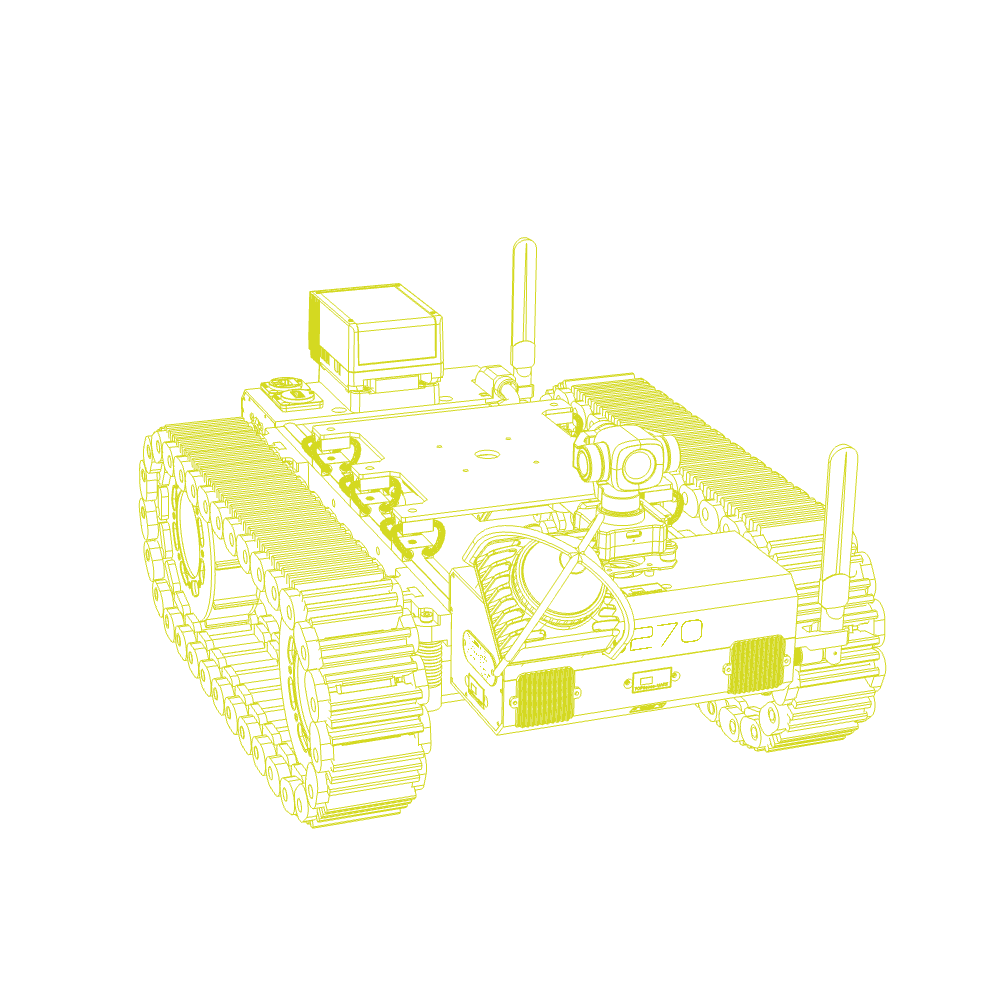
Defense small UGV
for reconnaissance in confined and high-risk environments
The N270 UGV supports close-range reconnaissance, sensor deployment and remote observation where larger ground robots are too bulky or too slow to deploy.
Modern operations often require fast, low-signature access to spaces that are narrow, cluttered, indoor or otherwise difficult to approach safely. The N270 UGV fills the gap between improvised small rovers and large military UGVs by offering a compact, robust and field-practical platform for close-range reconnaissance and mission support.
Why small matters
In many scenarios, size is not a limitation but an advantage. A compact UGV is easier to transport, faster to deploy and better suited for buildings, corridors, entry points, technical infrastructure and confined terrain.
Where larger systems become cumbersome, the N270 UGV remains practical. It can support operators with live video, payload transport and precise remote positioning in areas that are too exposed, too narrow or too uncertain for immediate human access.
Typical mission scenarios
The N270 UGV is suited for:
- indoor reconnaissance
- entry point assessment
- short-range route and corridor inspection
- sensor or camera placement
- observation in denied or uncertain spaces
- support in technical or industrial defense environments
Operational benefits
Key operational advantages include:
- compact footprint for confined spaces
- rapid deployment with low logistical burden
- remote visual access before personnel entry
- modular payload approach
- scalable path from teleoperation to assisted mission functions
From operator platform to mission platform
The N270 UGV can be positioned as a robust teleoperated system for immediate use, or as a higher-value mission platform with software-assisted functions such as mapping, sensor fusion and autonomy modules. This allows users to start with a practical operational tool and expand toward more advanced mission capabilities over time.